John Mcallister
November 19 to December 19, 2026
Almine Rech, Abdijstraat 20 / Rue de l’Abbaye, BrusselsTuesday – Saturday 11am – 7pm
Almine Rech Brussels is pleased to present ‘some ecstasies enthrall,’ John McAllister’s fifth solo exhibition with the gallery, on view from November 19 to December 19, 2026.
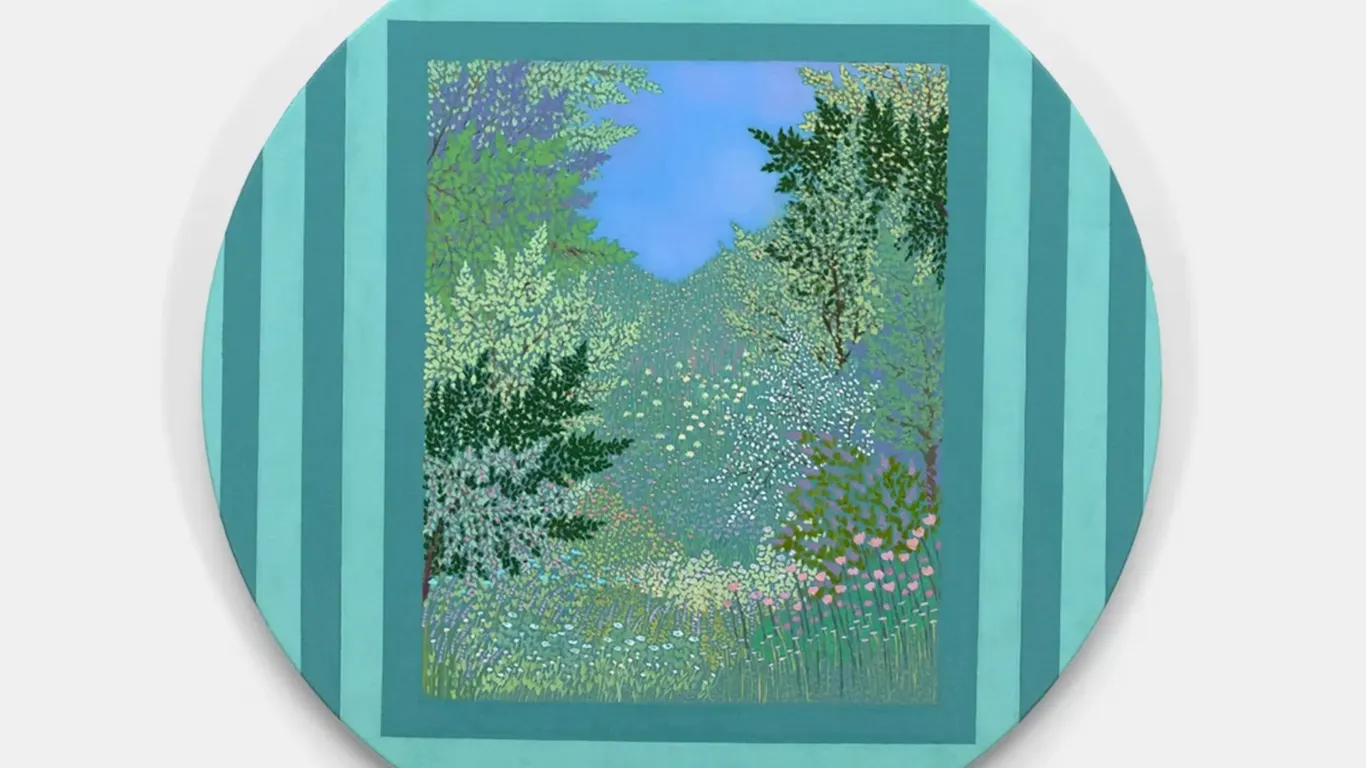
In his poem “Entrance”, Rainer Maria Rilke writes: “Whoever you are: step out of doors tonight, / Out of the room that lets you feel secure.” Once outside, he asks the reader to look at a tree set against the sky. In doing so, he promises, “You have made the world and all you see.” 1 Rilke’s call to contemplation echoes across John McAllister’s new body of work, which centres the idea of being “struck” by a landscape, featuring paintings that act as entrances, portals to experience and emotion. In a recent conversation, McAllister mused on the double entendre: entrance/to be entranced.For the last thirteen years, McAllister has lived and worked in Western Massachusetts, near the Berkshires. While the region shapes his sensibility, his paintings are far from literal depictions of local vistas. Realism is never the intention; it is sensation that McAllister is after, pure feeling. Rather than setting off into the field, sketchbook in hand, he lives a life intrinsically tied to nature, absorbing each detail as he bikes, hikes, or drives around his home, letting the environment fill him up and reemerge spontaneously, mysteriously in the studio. He faces the canvas, imagines a scene, and begins working. McAllister characterises it as a race against his own imagination: “You’ve just got to pin it down before it runs away.” The paintings are built through colour and accumulation, featuring loose yet searingly precise brushstrokes. Several works feature patterned borders and bright trompe l’oeil frames that lead the eye, formally denoting a point of entry. The conceit of the frame reverberates across the compositions, which often feature clearings that bring a definite focal point to the landscape.Though McAllister is in constant dialogue with art history, the staffage figures of his peintre paysagiste forebears are absent from his work. This is a deliberate choice, as the artist wishes for us, the viewers, to stand in as figures, participating in the construction of the composition itself. His unpopulated scenes recall Melville, who described the solitary beauty of the Berkshires in Israel Potter: “You would not have the country more settled if you could. Content to drink in such loveliness at all your senses, the heart desires no company but nature.” 2. Yet McAllister is also interested in the changes man has brought to the environment: non-native flora (the artist joked that his incongruous mixes of plant species would give botanists a headache), reservoirs, and clearings. McAllister describes this as “non-natural nature” and has long been fascinated by the tension between the indigenous and the constructed.To be a painter of landscapes in 2026 is also to grapple with climate change. Just as invasive plants and human intervention intrigue McAllister, so do smoky skies and technicolour sunsets created by wildfires. These phenomena are causes for alarm, yet they can also be aestheticised, blending malaise and beauty. McAllister mentioned a sense of urgency in capturing the emotional experience of being outside, which has begun to feel increasingly fleeting. In an era where many experience nature exclusively through screens, McAllister’s work serves as an invitation to return to the senses and surrender to experience itself, in all its emotional complexity.— Louisa Mahoney, researcher Courtesy Almine Rech