Silver Art Auction, Now until December 20th, 2026Silver Art Auction, Now until December 20th, 2026
DiscoverGuidesWorkspace

Roy Lichtenstein

Roy Lichtenstein unclaimed

Southampton and Manhattan • b. 1923

0 followers

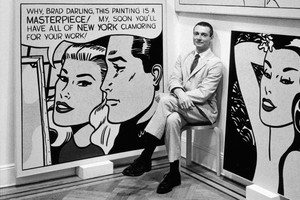
Pop Art looks out into the world. It doesn’t look like a painting of something, it looks like the thing itself. —Roy Lichtenstein Roy Fox Lichtenstein’s (1923–1997) high-impact, iconic paintings have become synonymous with Pop art—a movement he helped originate—and his merging of mechanical reproduction and hand drawing has become central to the critical understanding of the movement. Born in New York, Lichtenstein developed an interest in drawing, science, and jazz music at a young age. He attended Ohio State University (1940–42), before being drafted into the Army (1943–45). Supported by the G.I. Bill following the war, Lichtenstein resumed his art studies at the School of Fine and Applied Arts at Ohio State and graduated with an MFA in 1949. He stayed in Ohio for the next eight years, working first as a teacher and later as an industrial draftsman and furniture designer, among other part-time roles. Lichtenstein then accepted an assistant professorship in industrial design at the State University of New York, Oswego, which led to a teaching position at Douglass College at Rutgers University, New Jersey. In 1961 Lichtenstein painted one of his first Pop paintings, Look Mickey . This work, in its use of cartoon characters and deliberate imitation of the Benday dot commercial printing process, marked a major turning point in his career. Lichtenstein had his first solo show with Leo Castelli in early 1962—which sold out before the opening—and another in 1963. After this commercial success with Castelli, he resigned from Rutgers in 1964 and moved back to New York to concentrate exclusively on his art. Into the next decade, he depicted stylized landscapes, consumer-product packaging, romantic scenarios, war scenes and explosions, adaptations of paintings by famous artists, parodies of Abstract Expressionism, and geometric elements from Art Deco design. Despite their immense variation in subject matter, all these works underline the contradictions of representing three dimensions on a flat surface. The late 1960s saw Lichtenstein’s first museum surveys: in 1967 the Pasadena Art Museum, California, initiated a traveling retrospective; in 1968 the Stedelijk Museum, Amsterdam, presented his first European retrospective; and in 1969 he had his first New York retrospective, at the Solomon R. Guggenheim Museum. He began living in Southampton, New York, in 1968, and in 1984 he acquired a studio loft in Manhattan; thereafter he would split his time between Southampton and Manhattan.
Artist tags

  • Painting
  • Drawing
  • Print

Exhibitions

Roy Lichtenstein
Kunstmuseum Basel

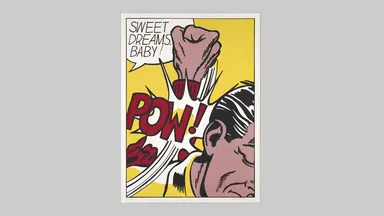
Sweet Dreams, Baby!

Aug 22, 2026 to Jan 3, 2027

Roy Lichtenstein
Whitney Museum of American Art

Roy Lichtenstein: Like New

Oct 11, 2026 to May 10, 2027

Roy Lichtenstein
Whitney Museum of American Art

Roy Lichtenstein: 1997

From September 5, 2026

No upcoming exhibitions listed.

No past exhibitions listed.

Artwork

Roy Lichtenstein

Untitled Head

Roy Lichtenstein

Landscape with Poet

Roy Lichtenstein

REPEATED DESIGN

Roy Lichtenstein

Surrealist Head, 1986

Painted and patinated bronze

200.7 x 71.1 x 44.1 cm

Roy Lichtenstein

Moonscape (Study), 1984

Coloured pencil, graphite pencil on paper

19,1 × 26,4 cm (7.52 × 10.39 in) Image 8,6 × 13 cm

Roy Lichtenstein

Artemis and Acteon, 1987

Oil, acrylic on canvas

213 x 305.4 cm

Roy Lichtenstein

View from the Window (Study), 1984

Coloured pencil, graphite pencil on paper

26.4 x 18.7 cm

Roy Lichtenstein

Brushstroke Head III, 1987

Painted and patinated bronze

73.7 x 50.2 x 29.2 cm

Roy Lichtenstein

Landscape with Scholar’s Rock, 1997

Oil and Magna on canvas

79 × 156 in

Roy Lichtenstein

Endless Drip, 1995

Painted and fabricated aluminum

142 ¼ × 13 ½ × 4 ½ in (361.3 × 34.3 × 11.4 cm), edition of 3

Roy Lichtenstein

Nude with Bust (Study), 1995

Tape, marker, and painted and printed paper on board

53 ⅞ × 44 ⅞ in

Roy Lichtenstein

Times Square Mural, 1990 (fabricated 1994, installed 2002)

Porcelain enamel on steel, in 16 parts

overall: 73 in × 53 feet (185.4 cm × 16.2 m), NYCT Times Square–42nd Street Station, commissioned by Metropolitan Transportation Authority Arts & Design

Roy Lichtenstein

Mobile III, 1990

Painted and patinated bronze

57 × 52 × 13 in (144.8 × 132.1 × 33 cm), edition of 6

Roy Lichtenstein

Profile Head, 1988

Painted and patinated bronze

36 ⅝ × 22 ½ × 9 ½ in (93 × 57.2 × 24.1 cm), edition of 6

Roy Lichtenstein

replica of Greene Street Mural, 1983 (destroyed)

Magna, printed paper, and tape on wall

18 feet × 95 feet 8 in (5.5 × 29.2 m), installed at Gagosian, West 24th Street, New York, September 10–October 17, 2015

Roy Lichtenstein

Abstract Painting, 1983

Oil and Magna on canvas

70 × 54 in

Roy Lichtenstein

Sunrise Over Water, 1982

Oil and Magna on canvas

66 × 112 in

Roy Lichtenstein

The White Tree, 1980

Oil and Magna on canvas

105 × 210 in

Roy Lichtenstein

Expressionist Head, 1980

Painted and patinated bronze with painted wooden base

55 × 41 × 18 in (139.7 × 104.1 × 45.7 cm), edition of 6

Roy Lichtenstein

Mirror II (maquette), 1977

Painted wood

59 ¾ × 30 × 12 in

Roy Lichtenstein

Entablature, 1974

Magna, sand, Magna medium, and aluminum powder on canvas

60 × 100 in

Roy Lichtenstein

Cape Cod Still Life II, 1973

Oil and Magna on canvas

60 × 74 in

Roy Lichtenstein

Peace through Chemistry, 1970

Oil and Magna on canvas

100 × 180 in

Roy Lichtenstein

Compositions III, 1965

Magna on canvas

56 × 48 in