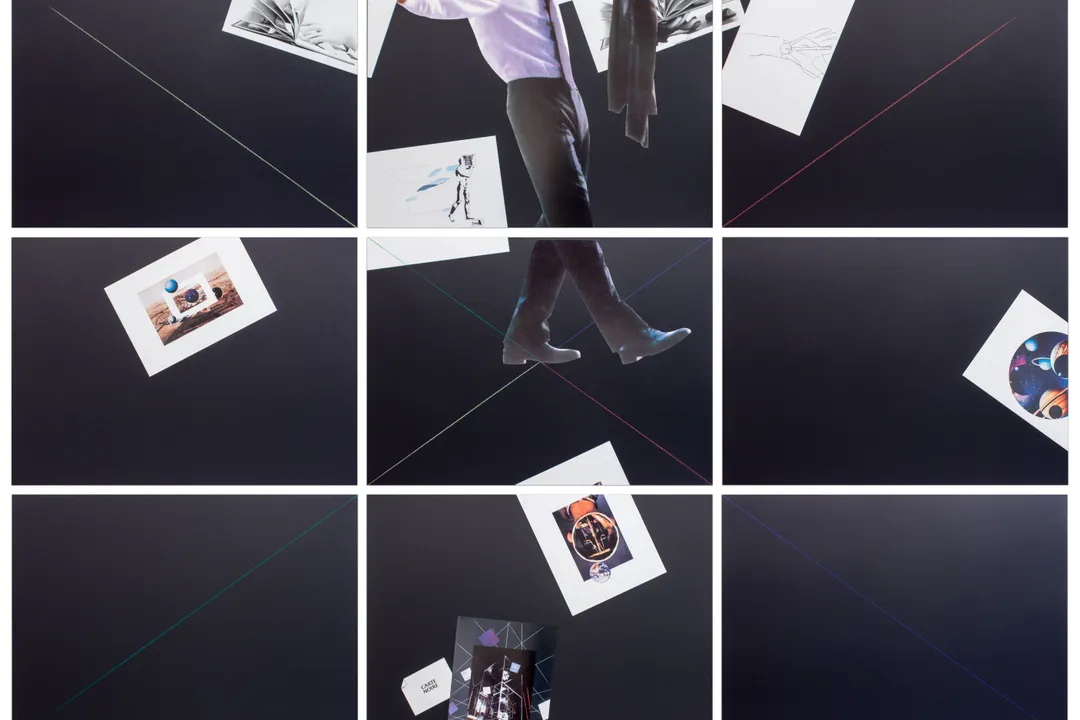
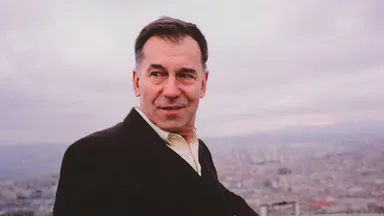
Turin • b. 1940
Giulio Paolini was born in Genoa on November 5, 1940, but spent his childhood in Bergamo, where his family had moved due to his father’s professional commitments. At the age of eight, he won a drawing prize judged by a panel chaired by Felice Casorati. In 1952, he moved to Turin, where he graduated in graphic design in 1959. During his school years, he began approaching the art world as an observer, visiting exhibitions and reading contemporary art publications and magazines. Gradually, he also developed an interest as a creator. Around 1958, in the attic of his home, he began experimenting with abstract, monochromatic paintings—small oil works on cardboard. In the second half of 1960, at just twenty years old, he created Disegno geometrico , likely his first work on canvas and the piece he considers his first “authentic” artwork. In 1964, he held his first solo exhibition at La Salita gallery in Rome. The show led to his first sales and critical reviews, including one by Carla Lonzi, who later invited him to participate in a group exhibition alongside Carla Accardi, Enrico Castellani, Michelangelo Pistoletto, and Cy Twombly, where he presented the work 2200/H (1965). From that point on, exhibition opportunities multiplied, and his network of gallerists and art critics expanded. During this period, he met Lucio Fontana and Alighiero Boetti, with whom he felt a strong artistic affinity. Germano Celant, whom he met through Carla Lonzi, wrote the catalogue essay for a solo exhibition at the Galleria del Leone in Venice in 1967 and involved Paolini in the emerging Arte Povera movement. Major retrospectives of his work have been held at the Stedelijk Museum in Amsterdam (1980), the Nouveau Musée in Villeurbanne (1984), the Staatsgalerie Stuttgart (1986), the Galleria Nazionale d’Arte Moderna in Rome (1988), the Neue Galerie am Landesmuseum Joanneum in Graz (1998), and the Fondazione Prada in Milan (2003). More recent survey exhibitions include those at the Whitechapel Gallery in London (2014), the Fondazione Carriero in Milan (2018), and the Castello di Rivoli Museum of Contemporary Art in Rivoli-Turin (2020). Paolini has taken part in numerous Arte Povera exhibitions and has been invited multiple times to Documenta in Kassel (1972, 1977, 1982, 1992) and the Venice Biennale (1970, 1976, 1978, 1980, 1984, 1986, 1993, 1995, 1997, 2013). He has also designed sets and costumes for theater productions, most notably in collaboration with Carlo Quartucci during the 1980s and for two operas by Richard Wagner directed by Federico Tiezzi (2005, 2007). His works are now part of the collections of prestigious institutions such as the Solomon R. Guggenheim Museum in New York, the Stedelijk Museum in Amsterdam, and Tate Modern in London, among others. In 2022, he was awarded the Praemium Imperiale for Painting, the most prestigious international art prize. Paolini lives and works in Turin.