Los Angeles • b. 1937
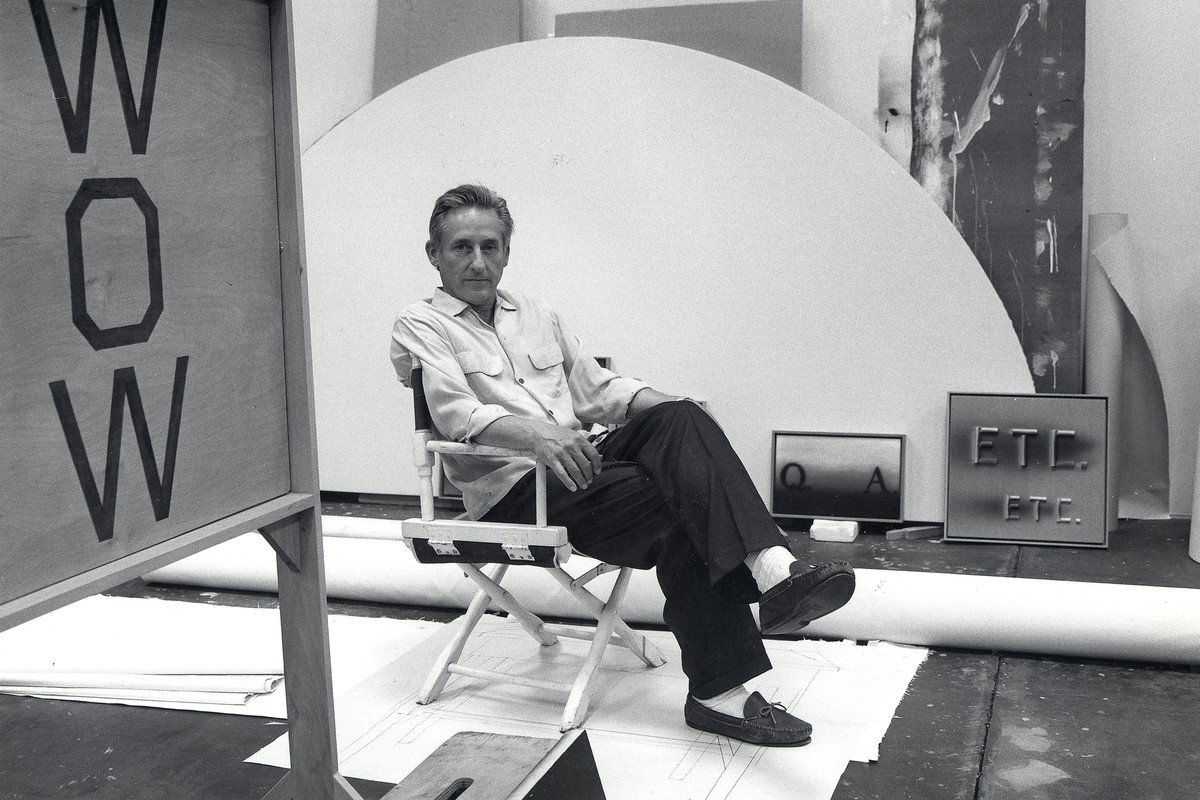
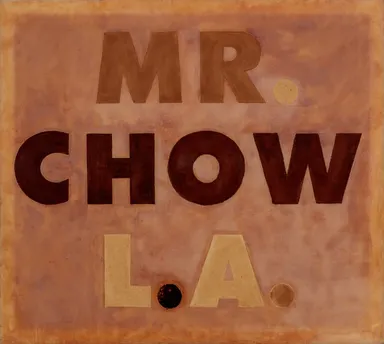
There are things that I’m constantly looking at that I feel should be elevated to greater status, almost to philosophical status or to a religious status. That’s why taking things out of context is a useful tool to an artist. It’s the concept of taking something that’s not subject matter and making it subject matter. —Ed Ruscha At the start of his artistic career, Ed Ruscha called himself an “abstract artist . . . who deals with subject matter.” Abandoning academic connotations that came to be associated with Abstract Expressionism, he looked instead to tropes of advertising and brought words—as form, symbol, and material—to the forefront of painting. Working in diverse mediums with humor and wit, he oscillates between sign and substance, locating the sublime in landscapes both natural and artificial. In 1956, Ruscha moved from Oklahoma City to Los Angeles, where he attended the Chouinard Art Institute. During his time in art school, he had been painting in the manner of Franz Kline and Willem de Kooning, and came across a reproduction of Jasper Johns’s Target with Four Faces (1955). Struck by Johns’s use of readymade images as supports for abstraction, Ruscha began to consider how he could employ graphics in order to expose painting’s dual identity as both object and illusion. For his first word painting, E.Ruscha (1959), he intentionally miscalculated the space it would take to write his first initial and surname on the canvas, inserting the last two letters, HA, above and indicating the “error” with an arrow. After graduation, Ruscha began to work for ad agencies, honing his skills in schematic design and considering questions of scale, abstraction, and viewpoint, which became integral to his painting and photography. He produced his first artist’s book, Twentysix Gasoline Stations— a series of deadpan photographs the artist took while driving on Route 66 from Los Angeles to Oklahoma City—in 1963. Ruscha since has gone on to create over a dozen artist’s books, including the 25-foot-long, accordion-folded Every Building on the Sunset Strip (1966) and his version of Jack Kerouac’s iconic On the Road (2009). Ruscha also paints trompe-l’oeil bound volumes and alters book spines and interiors with painted words: books in all forms pervade his investigations of language and the distribution of art and information. Ruscha’s paintings of the 1960s explore the noise and the fluidity of language. With works such as OOF (1962–63)—which presents the exclamation in yellow block letters on a blue ground—it is nearly impossible to look at the painting without verbalizing the visual. Since his first exhibition with Gagosian in 1993, Ruscha has had twenty-one solo exhibitions with the gallery, including Custom-Built Intrigue: Drawings 1974–84 (2017), comprising a decade of reverse-stencil drawings of phrases rendered in pastel, dry pigment, and various edible substances, from spinach to carrot juice. The first retrospective of Ruscha’s drawings was held in 2004 at the Whitney Museum of American Art, New York. He continues to experiment with form and make use of the American vernacular, reflecting on its evolution as online technologies alter the essence of human communication. Ruscha represented the United States at the 51st Biennale di Venezia (2005) with Course of Empire , an installation of ten paintings. Inspired by nineteenth-century American artist Thomas Cole’s famous painting cycle of the same name, the work alludes to the pitfalls surrounding modernist visions of progress. In 2018 Ruscha’s Course of Empire was presented concurrently with Cole’s at the National Gallery in London. ED RUSCHA / NOW THEN opened at the Museum of Modern Art, New York, in 2023 and traveled to the Los Angeles County Museum of Art in 2024. The artist’s first comprehensive retrospective in more than twenty years, it included over 250 works from his more than six-decade career, illuminating both emblematic and lesser-known aspects of a practice that has influenced artists, designers, and writers worldwide.